

This website is no longer active.
The activities of this association have been transferred to Automotive Mobility Europe (AME).
For updated information, please visit:
www.automotivemobilityeurope.eu

What does CECRA do?

CECRA is the European umbrella organisation regrouping national automotive trade associations and European brand dealer councils
Acting as a watchdog, ensuring the interests of authorized dealers and repairers are taken into due account by European regulatory bodies

CECRA's 'Best Practice'
platform offers its members a real added value enabling them to learn more about new tendencies and best practices in place
Welcome to
The Voice of European vehicle dealers and repairers
Representing 336,720 enterprises of automotive trade and repair businesses
Latest News

Merger of AME and CECRA completed: AME is now the unified voice representing distribution, services and after-sales sectors of individual mobility in Europe
Brussels, 01/04/2026
A new major automotive organization representing dealers, repairers and mobility services has been launched in Brussels. Automotive Mobility Europe (AME) and the European Council for Motor Trades and Repairs (CECRA) have completed their merger on 31 March 2026.
AME brings together leading national associations representing the automotive and mobility services ecosystem across Europe - from dealers to repair shops, independent and franchised companies - as well as European Dealer Councils, into a single, stronger European body.
The initiative ensures that the sector’s priorities are effectively represented at the highest levels of EU policymaking. AME will work to promote fair regulation, safeguard market access, and strengthen support for SMEs.
“We launched the idea of creating a new strong alliance in Paris in 2025. I am deeply satisfied that the merger between CECRA and AME has now been completed. AME is built on a shared ambition to create a united voice at EU level to ensure strong representation, foster innovation, and support the sustainable transformation of mobility across Europe”, said Xavier Horent, CEO of Mobilians and Co-President of AME. “We have a lot of work ahead of us. Our industry is experiencing one of the most significant transformations in recent decades. This requires our full attention and a strong, united voice in Brussels. We look forward to working together in AME at this crucial time for the sector, and we look forward to further strengthening and expanding our partnerships in Brussels”, said Jürgen Hasler, CEO of ZDK and Co-President of AME.
“For more than 40 years CECRA has been the trusted voice of dealers and repairers in Brussels. By joining forces in AME, we are creating a stronger and more influential organization at a critical moment, as the automotive industry undergoes a major transformation. I am proud we have taken this step to become even more influential for the benefit of our members across Europe. We look forward to bringing our expertise to the EU Institutions through AME”, says Peter Daeninck, President of CECRA.
AME is now the authoritative and unified voice of the automotive retail and repair and mobility services sector.
CECRA and AME would like to thank Peter Daeninck for his longstanding leadership and his key role in bringing this merger to fruition. His contribution has been essential in shaping this new European organization as well as his dedication to the sector throughout many years.
The automotive omnibus reframes the 2035 targets
Europe must now strengthen the foundations of climate-neutral mobility
Brussels, 17/12/2025
CECRA welcomes the long-awaited automotive omnibus package as a significant step towards greater regulatory clarity. While the outcome represents progress, CECRA and its members had hoped for less headline and more substance in the Commission’s announcement.
Attention must now turn decisively to ensuring a successful transition in practice. This requires complementary EU policies that deliver large-scale infrastructure and stimulate demand for both new and used electric vehicles across all Member States.
The overall direction is clear: Europe’s automotive sector and its customers need a credible, supportive, and economically sustainable pathway towards clean mobility.
The omnibus package brings regulatory simplification and extends technological openness beyond 2035, allowing manufacturers to continue offering plug-in hybrid and range-extender vehicles. By enabling a 90% fleet CO₂ reduction rather than a de facto 100% ban, the European Commission maintains flexibility while safeguarding the climate objective through corresponding upstream compensation measures.
However, regulatory adjustment alone will not suffice. The central challenge remains to accelerate consumer demand.
From the viewpoint of Europe’s dealers and repairers, those closest to the customer, the gaps are clear. Electric mobility remains unevenly affordable, inconsistently incentivised, and insufficiently supported by infrastructure. High battery replacement costs, fragmented charging networks, and local grid limitations continue to weaken consumer confidence. CECRA also underlines the importance of segment-specific approaches, as the market dynamics for passenger cars and light commercial vehicles differ substantially.
The next phase of EU policy must therefore focus on practical implementation rather than new targets:
-
Consumer care and repairability: Particularly for batteries, must improve. Repair and refurbishment should become the default, helping control costs and maintain trust.
-
Charging infrastructure: Needs to become simpler, more affordable, and transparent, with faster expansion beyond metropolitan areas and concrete solutions for drivers without private parking.
-
Electricity grids: Must be reinforced to manage rising demand, ensuring electrification becomes an enabler—not a constraint.
-
Used-vehicle market: Should become a clear policy priority. Broad adoption depends not only on new sales but also on the availability of affordable, reliable second-hand electric and hybrid vehicles with predictable residual values.
Targets will be impossible to be achieved if the conditions for achieving them are not there,” said CECRA President Peter Daeninck in a statement. “There must be a clear road and a vehicle to reach the destination. The European Union needs to put focus on consumers and the real constraints faced all stakeholders; consumers, retail (mostly SME’s) and manufacturers. Only than the targets can be achieved.”
CECRA reaffirms its full support for Europe’s climate goals and the decarbonisation of road transport. Nonetheless, success will ultimately be defined by consumer adoption, not regulation alone. The European Commission must now focus on delivering measures that unlock demand and make electric mobility a viable choice for all Europeans.
The automotive omnibus represents a cornerstone for the coming years. CECRA stands ready to engage constructively in discussions on implementing the measures announced today.
Greening Corporate Fleets
Brussels, 09/12/2025
In our communications, we have consistently stated that this measure can only be effective if accompanied by complementary measures that support the used car market and vehicle repairability, with the objective of reducing the total cost of ownership.
Introducing the Greening Corporate Fleets initiative in isolation will not support the market; rather, it risks creating market imbalance and leaving the retail sector to bear the negative consequences.
As this measure currently appears unlikely to be accompanied by such flanking policies, we are compelled to issue this strong signal.

CECRA and AME join forces to represent the automotive and mobility services in Brussels
Brussels, 29/09/2025
At its General Assembly held on 24 September in Budapest, CECRA (European Council for Motor Trades and Repairs) approves the launch of a merger process with Automotive Mobility Europe (AME), a European association founded in 2025 by eight national associations representing the automotive services sector in Europe. CECRA is an integral part of the heritage of automotive services. The goal of the new association - AME - will be to engage in high-level dialogue with European decision-makers and other stakeholders in the sector, including manufacturers, suppliers, consumer associations, and environmental organizations.
This decision marks a significant milestone in the effort to unite and strengthen the voice of the European automotive trade and repair sector, and of the mobility ecosystem more broadly. The strategic integration aims to enhance representation, advocacy, and effectiveness at the European level, ensuring a stronger, more cohesive industry presence.
AME, co-chaired by Xavier Horent (MOBILIANS – France) and Jürgen Hasler (ZDK – Germany), together with CECRA President Peter Daeninck, supported by the CECRA Board, stated that this merger represents a significant step forward in shaping the future of the European automotive trade, repair, and mobility landscape.
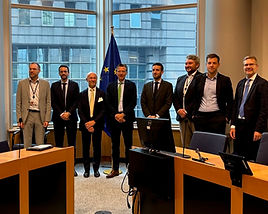
Driving EV adoption in Europe: "Trust, Transparency and Affordability must come first"
Brussels, 02/10/2025
Accelerating electric vehicle (EV) uptake in Europe hinges on three pillars: trust, transparency, and affordability. That was the clear message from an event hosted at the European Parliament by MEP Gerben-Jan Gerbrandy (Renew) in partnership with CECRA, the European Council for Motor Trades and Repairs.
The high-level roundtable brought together EU policymakers, industry leaders, and experts including representatives from the European Commission, BEUC, Leaseurope, and Transport & Environment - to discuss how to make the EV transition work for all Europeans.
“We can’t build the EV market without the consumer and the consumer still has doubts,” said CECRA President Peter Daeninck. “Dealers are the first point of contact for buyers. We know what they need, and our voice must be heard in shaping the EU Automotive Action Plan.”
CECRA stressed that both the new and used EV markets need targeted and sustained support, including financial incentives. Despite progress, EVs remain out of reach for many consumers, with persistent concerns over high purchasing price, limited charging infrastructure, and unclear public charging prices. “Smart charging and cheaper electricity could be game changers, but they’re not mainstream yet,” added Daeninck.
The discussion also touched on the European Commission’s upcoming proposal for greening corporate fleets. CECRA warned that setting mandatory zero-emission targets for fleets risks widening the gap between supply and real consumer demand, especially in the used market. “A thriving second-hand EV market is key to making stricter fleet targets both realistic and effective,” said Daeninck. The Commission confirmed that an impact assessment on corporate fleet regulation is underway.
“The future is electric. While others fight for outdated markets and technology, hoping things will stay sweet and smooth, the reality is not that. Policymakers must focus on the transition ahead. It's a societal change that demands collaboration with all stakeholders and citizens” stated MEP Gerben-Jan Gerbrandy
Restoring trust in the second-hand EV market was a shared priority. Participants called for better information on battery health, improved repairability of EV components, and more transparent pricing on charging, all essential to boost buyer confidence.
“Electrification only works if there’s a real market demand,” Daeninck concluded. “It’s not enough to produce EVs, people must want them and be able to afford them.”

Independent Service Providers (ISP) group welcomes the Data Act entry into application, but cautions against deregulation
Brussels, 12/09/2025
The Independent Service Providers (ISP) group welcomes the official entry into application of the Data Act today, 12 September 2025, and acknowledges the publication of the sector-specific Guidance Document for the automotive industry. These are important milestones for Europe’s digital transition and a crucial step towards fair and transparent data-sharing in the automotive sector.
The Data Act establishes important principles: it gives users of IoT devices rights over the data they generate, ensures that such data can be shared with third parties of their choice, and sets obligations on data holders to make information transparent and accessible. For the automotive aftermarket, an efficient application of the Act is particularly relevant, as it provides a horizontal legal framework to begin addressing the challenges of fair access to vehicle-generated data.
The Data Act thereby intends to give fair access to vehicle data to secure competition, support innovation, promote the development of competitive European connected mobility services and ensure consumers benefit from affordable and sustainable mobility services.
Simplification must not mean deregulation
While supporting genuine efforts to streamline compliance, ISPs caution against calls to recast the Data Act as voluntary or weaken core obligations under the auspices of reducing administrative burdens notably through the upcoming Digital Omnibus.
Such approaches risk undermining the very objectives of the Act:
-
For independent service providers, the real barrier to competitive digital mobility services is not paperwork, but restricted access to vehicle data. Diluting the Data Act would entrench market asymmetries, benefiting only a handful of dominant players.
-
Voluntary frameworks cannot substitute binding rules where structural imbalances exist, as experience in the automotive sector has already demonstrated.
Simplification must not be mistaken for deregulation. To foster trust, ensure legal certainty, and enable all businesses – particularly SMEs – to compete and innovate, Europe requires clear and enforceable rules.
Effective enforcement is key
The ISP group is also concerned by indications that the Data Act might be implemented with only “soft” enforcement. Without robust and harmonised oversight across Member States, the rights and obligations enshrined in the Data Act risk remaining only on paper.
ISPs therefore call on the European Commission and Member States to:
-
Ensure that enforcement is consistent, strong and effective across the Union;
-
Safeguard the integrity of the Data Act from attempts to reopen or dilute it through upcoming legislative packages;
-
Recognise the Act as the first step towards sector-specific legislation (SSL) to fully address the challenges of fair in-vehicle data access.
The ISP group reaffirms its commitment to working constructively with policymakers, businesses and stakeholders to build a competitive, innovative and consumer-oriented automotive ecosystem underpinned by fair access to vehicle data, and intends to make use of the legislative instrument provided by the European Commission while reporting on its practical implementation.
Signed by:
ADPA – AIRC – CECRA – CLEPA – EGEA – ETRMA – FIA – FIGIEFA – Insurance Europe – Leaseurope


